Fishing Licence Checklist

Select your province and check off each requirement as you prepare.

Printable downloads

Free Fishing Licence Checklists

Save the general checklist or choose a province-specific version for the account and licence system you need.

General checklists

Province checklists

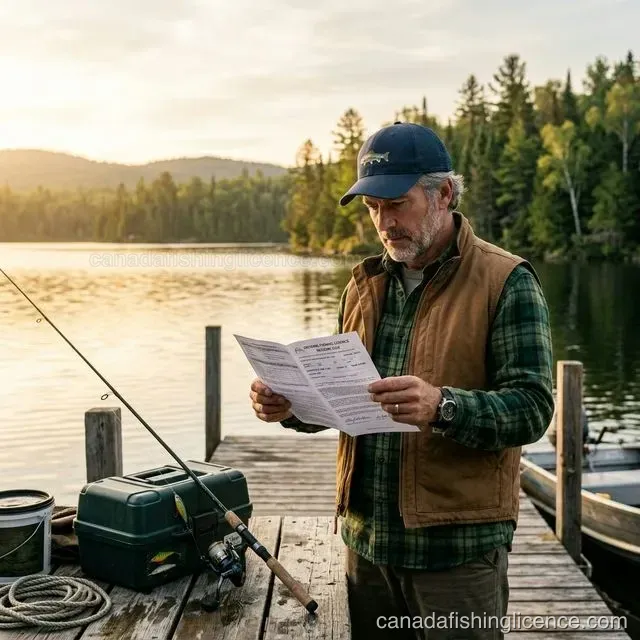
An angler checking fishing licence documents on a Canadian lakeside dock at golden hour
Checking your licence requirements before heading out saves time and avoids fines.

Interactive Licence Checklist

Choose a province and mark each requirement as you prepare.

0 of 5 required steps complete

Why Requirements Differ Across Provinces

Canada's fishing licensing is managed independently by each province and territory, which means the documents, cards, and registrations you need can vary significantly depending on where you fish. Ontario's system, for example, requires anglers to first obtain an Outdoors Card — a separate identification card that serves as the foundation for all hunting and fishing licences in the province. Check the official Ontario resident licence rules for the youth and senior exceptions. Alberta uses a Wildlife Identification Number (WiN). British Columbia's WILD system requires anglers to register for a free Fish and Wildlife ID (FWID) before purchasing a freshwater licence. PEI uses an angling licence plus an age- and product-dependent Wildlife Conservation Fund path, and the province says online licences must be printed and signed before fishing. And as of the 2026-27 season, Saskatchewan's Fisheries Habitat Certificate table applies to anglers age 16 to 64: the annual certificate is $21 and the one-day or three-day certificate is $5.25. Saskatchewan youth under 16, residents 65 and older, and eligible Canadian Armed Forces veterans have different licence or certificate rules, so check the official eligibility table before paying.

Beyond the licence itself, many provinces have additional requirements that are easy to overlook. Some species require supplementary stamps, tags, or surcharges. In BC, freshwater salmon retention can require the provincial non-tidal Salmon Conservation Surcharge, while tidal salmon retention uses the DFO Salmon Conservation Stamp. In the Northwest Territories, residents and Canadian residents under 16 or 65+ may be exempt from the standard licence, but Great Bear Lake and the Inuvialuit Settlement Region still require their own validation, and Edéhzhíe requires a separate permit. If you plan to fish in a national park such as Banff or Jasper, note that your provincial or territorial licence is not valid inside the park — you instead need a Parks Canada fishing permit, which follows its own park rules. The checklist above keeps those common extras visible while you plan.

Checks That Commonly Matter Across Provinces

These are useful checks in many jurisdictions, but the issuing authority decides the exact proof, limits, and gear rules for your water:

  • Accepted licence proof — Carry the document, app, ID, card, stamp, or record required by the issuing system for the licence or permit you hold. A printed or digital copy is only suitable where the local rules accept that format.
  • Knowledge of local regulations — Each province publishes an annual fishing regulations summary covering catch limits, size restrictions, bait rules, and area closures. Read it before you fish.
  • Species identification — You're responsible for correctly identifying any fish you catch. Keeping a fish of the wrong species or undersized fish can result in fines.
  • Proper gear — Most provinces restrict the number of lines, hooks, and gear types you can use. Check the Fishing Gear Checklist for a starter gear list.

Frequently Asked Questions

What do I need to go fishing in Canada?

Start by identifying the licence or permit system for the water: a provincial freshwater licence, a federal tidal-water licence, or a Parks Canada permit for a national park. Some provincial systems also require extra steps: Ontario uses an Outdoors Card, Alberta uses a Wildlife Identification Number (WiN), and Saskatchewan requires a Fisheries Habitat Certificate for anglers age 16 to 64 in the 2026-27 season, with separate youth, senior, and veteran rules. The province-specific checklists above cover the common planning steps.

Do I need separate licences for different provinces?

Yes. Fishing licences in Canada are issued by each province and territory individually — there is no national fishing licence. If you plan to fish in multiple provinces, you'll need a licence from each one. Check the Cost Calculator to compare prices across provinces.

Do children need a fishing licence in Canada?

Not always. Ontario and Canadian residents under 18 do not need to buy an Outdoors Card or licence when they carry the required identification. Alberta exempts children under 16. B.C. has separate resident and visiting-youth rules, so check the province checklist above before you go.

What identification do I need to buy a fishing licence?

Requirements vary by province and by product. You may need government-issued identification for age or residency, an account or card number, or a separate proof document. Ontario uses an Outdoors Card, while B.C.'s WILD freshwater path uses a Fish and Wildlife ID (FWID); check the local portal before assuming one document format will work everywhere.

Last updated: October 26, 2026. Requirements can change, so check the latest provincial rules before you travel.