Do Kids Need a Fishing Licence in Canada? 2026 Age Rules
Do kids need a fishing licence in Canada in 2026? Check Ontario under-18 and common under-16 rules, then separate visitor, tidal, salmon and park exceptions.
Children often do not need their own regular freshwater fishing licence, but Canada has no single age rule. Start with the province and residency class: Ontario residents and other Canadian residents under 18 usually fish without a licence, while many other provinces use an under-16 rule. Visitor children, seniors, B.C. tidal water, parks, and salmon trips can follow different rules.
Updated October 26, 2026
Do Kids Need a Fishing Licence in Canada?
A 15-year-old in Ontario usually does not need their own fishing licence for ordinary provincial freshwater fishing. Ontario residents and other Canadian residents under 18 fish under the youth exemption and should carry government-issued ID showing name and date of birth. The Ontario resident licence rules are the direct official starting point. A non-Canadian youth under 18 can fish without their own licence when accompanied by someone who holds a valid Ontario recreational fishing licence; fish kept count toward that person’s limit unless the youth buys their own licence. If the question names Ontario, a visitor child, tidal water, a park, or salmon, start with the matching section below. For broader planning, check the province pages or the federal-versus-provincial guide.
If the angler is visiting Canada, do the residency check before relying on an age exemption. The non-resident guide separates Canadian non-residents, U.S. visitors, and other international visitors; the federal-versus-provincial guide covers tidal water, salmon, and park permits that can sit outside the ordinary freshwater rule.
For the rest of Canada, there is no single national fishing licence age rule. Many provinces use an under-16 youth threshold, Ontario and Canadian resident youth in Ontario use under 18, and Quebec has resident youth certificate paths plus separate under-18 rules when a child fishes under a licence holder. Seniors usually need the resident senior rule, not just their age, and visitor children may need to fish with a licensed or exempt adult.
Ontario 15-year-old
Usually no licence for ordinary freshwater fishing
Ontario and Canadian resident youth carry ID. Non-Canadian youth normally need a licensed adult unless they buy their own licence.
Kids in Canada
Under 16 is common, but not national
The threshold changes by province, residency, water type, and species.
Seniors
Resident seniors often get a free or reduced path
Visitor seniors usually follow the non-resident rule unless the province says otherwise.
Special water
Tidal water, parks, or salmon can change the answer
B.C. tidal water and national parks use separate permit systems.
Parks Canada permits are separate from provincial age exemptions.
Question
Short answer
What to check next
Does a 15-year-old need a fishing licence in Ontario?
Usually no for ordinary provincial freshwater fishing.
Residency, ID, adult accompaniment for visitor youth, and catch-limit sharing.
Do kids need a fishing licence in Canada?
Often no under the local youth age; under 16 is common.
Province, water type, species, and whether the child is a visitor.
Do 16- or 17-year-olds need one?
Sometimes. Ontario still treats them as youth, but some provinces do not.
Free youth products, adult licences, salmon tags, and park permits.
Do seniors need a licence?
Resident seniors often get a free or reduced path.
Residency, province, and whether the trip uses a non-resident licence.
For a 14-year-old: a 14-year-old often falls under a local youth exemption for ordinary provincial freshwater fishing, but there is no national rule. Check the province, residency, water type, species, and whether the trip is inside a national park before relying on the exemption.
For 16- and 17-year-olds: do not assume every teen is treated the same. Some provinces keep youth exemptions past 16, some sell no-cost youth licences, and some require a regular or salmon-specific path once the teen reaches the local threshold.
For seniors: resident anglers aged 65+ often receive free or reduced licences. The exact age, residency, species, and permit conditions vary. Visiting seniors should not assume a resident senior exemption applies to them; check the province or federal fishery before buying.
Age Paths
Keep Age Questions Tied To The Province And Water
These pages help after the first age check when the province, visitor status, tidal water, salmon, park boundary, or family trip changes the answer.
Age rules are easy to mix together because parents, teens, seniors, visitors, tidal anglers, salmon anglers, and park anglers are often asking different questions. Answer the angler type first: child, teen, senior, visitor child, or free-fishing-date participant. Province, water type, salmon, tidal water, park permits, cost, and fine risk come after the age check.
Province-named youth questions: check the province section below once the query names Ontario, Manitoba, Nova Scotia, PEI, or another province.
Visitor child or American family trip: check residency and catch-limit sharing before assuming a child or senior exemption applies.
Tidal, salmon, national park, or special-permit trip: check that special-water path before relying on an ordinary provincial youth or senior rule.
Free family fishing date: check the date rules only after the age rule is clear, because free dates do not always waive every salmon, park, or conservation rule.
When an Adult Is Helping a Child Fish
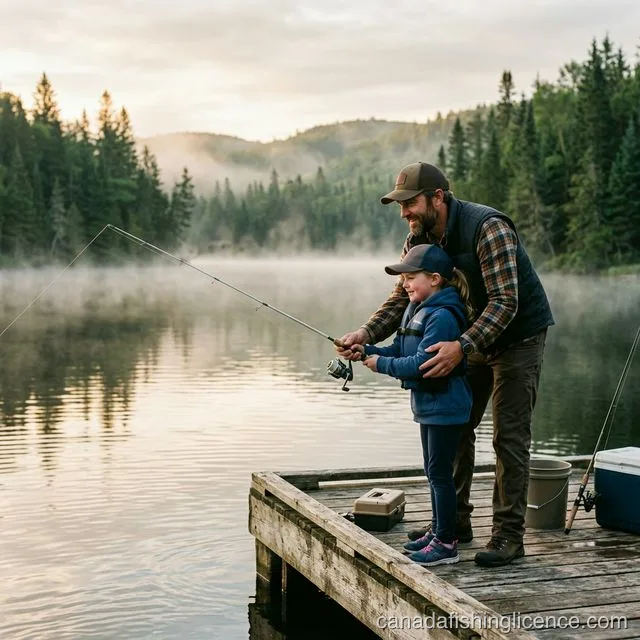
Family fishing trips often become confusing when an adult is doing part of the actual fishing for a child. The youth exemption may cover the child, but it does not automatically cover an adult who is actively fishing.
The practical rule: If you bait the hook, cast the line, set the hook, or actively reel in the fish, even if the fish is meant for your child, you may be treated as the person fishing. Provincial wildlife acts, including Ontario's Fish and Wildlife Conservation Act, define fishing broadly enough that the adult should hold the proper licence when hands-on help becomes active fishing.
Assistance is not a national rule: Verbal coaching, netting a fish after the child reels it in, unhooking a fish safely, or carrying the tackle may be treated differently from actively fishing. Ontario explicitly says an accompanying person does not need a licence when only assisting a person with a disability, but does need one if they engage in fishing; other provinces and fisheries can define hands-on help differently, so check the official local rule before relying on an exemption.
Ask before taking over the rod: Casting, holding a line in the water, setting the hook, or reeling for a child can change who is considered to be fishing. Treat those actions as a licence question rather than assuming that a brief turn with the rod is harmless.
The practical solution: If an adult will actively fish while helping a child, buy or carry the adult licence or permit that matches the province and water. See how to choose the right licence path if you are not sure which adult, youth, or family rule applies.
What ID Should Your Child Carry? Proof-of-Age Rules
Being exempt from buying a licence does not mean your child can fish with zero documentation. If a Conservation Officer approaches your family on the water, they may ask for proof of age before accepting the youth exemption.
Ontario has a clear written ID rule: Youth under 18 must carry government-issued identification showing their name and date of birth at all times while fishing. Acceptable ID includes a birth certificate, passport, health card, or provincial photo ID card. This piece of identification effectively is their fishing licence.
Non-resident youth at summer camps: Ontario has a specific provision — a non-Canadian youth attending an organized camp can use a photocopy of government-issued photo ID plus a camp identification card (listing the camp name, location, camper name, date of birth, and attendance dates) as a recognized fishing licence.
Other provinces: The age exemption and proof requirements vary by province and fishery. This guide does not establish a Canada-wide ID rule, so check the local licence or regulations page for the water you plan to fish. Carrying proof of age can still help when a province makes it part of the exemption.
For American families: If you are crossing the border for a fishing trip to Canada, keep each child's passport or accepted travel document accessible. That document can also help with age questions during a fishing licence check.
Ontario: Youth and Senior Rules
Ontario uses a higher youth threshold than many provinces and gives resident youth their own fishing privileges. Check the official Ontario resident licence page alongside this 2026 framework before you fish:
Youth under 18 (Resident): No Outdoors Card or fishing licence required. The child must carry government-issued ID with name and date of birth. They receive their own independent Sport-level catch limits, unlike provinces where youth share the adult's limit.
Youth under 18 (Non-Canadian resident): No licence required if accompanied by a person who has a valid Ontario recreational fishing licence. Fish kept count toward that person's limits. If the non-Canadian youth wants their own separate catch limits, they can buy an Outdoors Card and the applicable non-Canadian recreational fishing licence.
Seniors 65+ (Resident): Ontario residents 65 and older do not need an Outdoors Card or licence. They receive full Sport-level catch limits.
Veterans: Canadian Armed Forces veterans with valid military ID receive free fishing licences.
Disability: Ontario offers a free Resident Disability Outdoors Card with full fishing privileges.
Licence and event note: Ontario ticket amounts depend on the exact offence wording, and licence-free fishing periods are for Canadian residents with Conservation limits. Check the Ontario regulations or the free-fishing-days guide before relying on either detail.
British Columbia: The Freshwater vs. Tidal Split
BC needs an extra check. It has two separate licensing systems: provincial freshwater and federal tidal or saltwater. Each system uses different age rules.
BC Freshwater (Under 16 — Free): Resident youth under 16 do not need a licence and can use their own quota. Non-resident children under 16 can fish without a licence when accompanied by a licensed angler, but fish kept count toward that licence holder's quota unless the child buys their own non-resident licence.
BC Tidal / Saltwater (Under 16 — Free but registration still matters): Every angler of any age needs a Tidal Waters Sport Fishing Licence for ocean fishing in BC. For youth under 16, the licence costs $0.00. Register through DFO, carry the licence in the form DFO requires for the trip, and add a Salmon Conservation Stamp if retaining salmon.
The Salmon Conservation Stamp: If your child intends to retain any salmon (not catch-and-release), they must also have a Salmon Conservation Stamp attached to their tidal licence. This costs $7.39 and applies regardless of the angler's age. This is the main BC tidal case where an under-16 angler may still pay for fishing documentation.
DFO reporting note: Adult B.C. tidal licence holders must complete the assigned iREC report by the deadline even when they did not fish or retain anything. Juvenile licence holders do not complete an independent iREC report. Keep this reporting step separate from the age exemption and from the salmon stamp.
BC Senior Rate: BC residents 65+ pay a reduced annual freshwater licence rate. Non-resident seniors should check the regular non-resident freshwater price before buying.
Fine note: B.C. ticket amounts depend on the offence and the current schedule. Check the applicable B.C. rules before relying on a dollar amount; this age guide does not establish a single province-wide fine.
BC WILD note: BC freshwater licences now use WILD and FWID account steps. Youth tidal licences still use the separate federal DFO tidal path, so check whether the trip is freshwater or tidal before you register.
Alberta, Saskatchewan, Manitoba & Quebec
Alberta (Under 16 — Free, Own Limits): Youth are exempt from Alberta's WiN (Wildlife Identification Number) system. Like Ontario, Alberta gives youth their own independent catch limits. Seniors 65+ with Alberta residency fish for free. Canadian Armed Forces veterans also receive free licences with valid military ID. Check the current Alberta licence page for the applicable status and proof requirements.
Saskatchewan (Under 16 — Free): Anglers under 16 do not need an angling licence or the Habitat Certificate. Saskatchewan resident seniors 65+ are also exempt from both the fishing licence and the otherwise-mandatory Habitat Certificate. Angling without a valid licence can result in court-determined fines; serious hunting and fishing infractions were increased under 2014 amendments. Confirm the age and certificate path on the current Saskatchewan angling pages.
Manitoba (Under 16 — Free; residency changes limits): Manitoba residents under 16 may fish without an angling licence and have the privileges of a licence, including their own fish limit. The regulation defines a Manitoba resident as someone whose primary residence is in Manitoba and who has lived there for at least six consecutive months during the 12 months before applying for a licence or permit. Resident youth must show proof of age to an officer on request. Canadian and non-Canadian youth under 16 who are not Manitoba residents may fish without their own licence only when accompanied by a licence holder or someone exempt from holding one; their catch counts toward that person's limit. A youth in this category who wants a separate limit must buy an angling licence. Manitoba residents 65+ may fish without an angling licence if they can show proof of age and residence on request. Manitoba annual licences run May 1 to April 30. Check the current Manitoba Fishing Licensing Regulation and 2026 Manitoba Anglers' Guide for licence and exemption conditions.
Quebec (Resident Youth Certificate Path): Quebec residents under 18 can fish without buying a licence when they hold a Pêche en herbe or Relève à la pêche certificate from an introductory fishing activity. Children under 18 can also fish under a licence holder in listed situations. Any salmon caught under the youth certificate path must be released. Quebec residents 65+ pay a reduced senior rate of $21.21 for sport fishing. The Quebec regulation cycle is biennial: 2026–2027 regulations are in effect from April 1, 2026 to March 31, 2027. Check the Quebec licence page for the current youth and senior conditions.
Atlantic Canada: Nova Scotia, New Brunswick, PEI & Newfoundland
The four Atlantic provinces share broadly similar structures but diverge on important details, particularly around Atlantic salmon, which carries its own separate licensing requirement across the region.
Nova Scotia (Under 16 — Free): Youth under 16 do not need a general freshwater fishing licence and are also exempt from the salmon licence, which makes Nova Scotia different from the other Atlantic provinces. Youth under 16 receive their own daily bag limits. Resident seniors 65+ pay a reduced rate of $6.74 CAD for a general freshwater licence. Anglers 16 or older may need a separate salmon licence for salmon; youth 16-17 can use the no-cost youth salmon path, while adults and seniors should check the current salmon licence fee before buying. The Nova Scotia sportfishing licensing page is the current starting point for the product and handbook split.
New Brunswick (Under 16 — Free): The official non-resident licence table says anglers 0–15 do not need a general angling licence and have their own daily bag limit. For Atlantic salmon, youth aged 10–15 can fish without a licence when accompanied by a licensed salmon angler; the child's catch is included in the adult's daily catch-and-release limit. The current New Brunswick licence table separately lists the resident Class 8 salmon product for ages 10–15 and 65+, and the resident Class 10 angling product for ages 65+. A youth who wants an independent salmon limit must buy the applicable youth salmon licence and may be subject to a guide requirement. An NB Outdoors Card (free) is a prerequisite for purchasing a licence.
Prince Edward Island (Under 16 — Free, Courtesy Licence from Age 60): PEI has several separate age and status branches. Children under 16 do not need an angling licence; ages 16–18 and anglers 60+ can use a free Courtesy Angling Licence. PEI says angling licences include the Wildlife Conservation Fund (WCF) fee and publishes age-based WCF amounts: ages 16–64 generally pay $20 per year, ages 65+ pay $13, children under 16 are exempt, and active Canadian Forces members and veterans are exempt. PEI also lists courtesy licences for those military groups with the required identification. Read the current PEI Angling Resources and Information Centre before relying on an age or eligibility exception. For saltwater or tidal fishing, follow the DFO recreational fisheries path that PEI links from its current page rather than applying the freshwater age rule to every species.
Newfoundland & Labrador: The current provincial angling page confirms that inland fishery licences for salmon and trout are issued by the Wildlife Division and sold through commercial vendors or provincial government service centres. It sends anglers to the DFO Anglers' Guide for current season dates, licence details, and river rules. Do not carry a general Canadian youth or senior rule into Newfoundland and Labrador without checking that current guide and the specific salmon, trout, or coastal-water path.
The Territories: Yukon, NWT & Nunavut
Canada's three territories often have straightforward age rules, but salmon cards, national parks, special management areas, and land-claim rules can still change the path.
NWT age rule: Under section 27(1) of the Northwest Territories Fishery Regulations, an NWT resident or resident Canadian is exempt from the standard sport fishing licence only while under 16. A non-resident is exempt only while under 16 and accompanied by someone who holds a sport fishing licence. Anglers who are exactly 16 need the standard licence. GNWT’s licence table separately ties its under-16 and over-65 categories to a valid NWT or Canadian address; check residency classification before buying.
Yukon (Under 16 — Free, Seniors Free): Yukon resident youth under 16 can fish unsupervised and receive their own catch limits. Non-resident youth under 16 fish free but must be accompanied by a licensed adult, with their catch counting toward the adult's limits. Yukon lists a $100 fine for fishing without a licence. Salmon exception: Even exempt youth must obtain a free Yukon Salmon Conservation Catch Card if targeting salmon. Yukon residents 65+ fish for free. Check the current Yukon regulations summary for the local rule path before relying on the general age exemption.
Northwest Territories (Special areas): Special Management Areas and National Parks can require an added licence or permit at any age. Check Great Bear Lake, the ISR, Edéhzhie, or park rules separately from the standard licence path.
Nunavut (Under 16 — Free, Unique Land Claims): Beneficiaries of the Nunavut Land Claims Agreement (Inuit) have constitutionally protected fishing rights and do not require sport fishing licences. For non-beneficiaries: Canadian residents under 16 and non-residents under 16 accompanied by a licensed adult do not need a licence. Nunavut residents and Canadian residents over 65 still need a sport fishing licence, but the current fee table shows no fee.
Visitor note: Senior discounts are usually tied to Canadian or provincial residency. A visiting senior should usually plan around the non-resident licence rule unless the province says otherwise.
Province
Senior age
Resident cost or path
Key notes
Ontario
65+
Free
No Outdoors Card needed
Alberta
65+
Free
WiN exempt
Saskatchewan
65+
Free
Habitat Certificate also free
Manitoba
65+
Free
Proof of age and residency
British Columbia
65+
$5.71/yr
Freshwater only
Quebec
65+
$21.21/yr
Sport fishing category
Nova Scotia
65+
$6.74/yr
Check salmon fee if needed
New Brunswick
65+
Reduced rate
NB Outdoors Card (free) required
PEI
60+
Courtesy licence; WCF fee by age
65+ pay reduced WCF
Newfoundland
Check current guide
Licence details vary by salmon/trout path
Use the provincial seller route and current DFO Anglers' Guide
Yukon
65+
Free
Still need Salmon Catch Card
NWT
65+
Free
Including Canadian residents
Nunavut
65+
No-fee licence listed
Beneficiaries exempt
Military and veteran exemptions: Eligibility and proof requirements vary by province. In Manitoba, residents who are active or retired Canadian Forces members may fish without an angling licence if they can show proof of residence and a Canadian Forces Identification Card, Record of Service Card, or Canadian Armed Forces Veterans' Service Card when asked. Check the current provincial rule before relying on an exemption elsewhere.
Charter Boats & Guided Fishing: Do Kids Still Need Licences?
A charter booking does not by itself answer the licensing question for everyone on board. The applicable rule can depend on the province or federal fishery, the water type, the angler's age and residency, and whether the trip targets salmon or another managed species.
Confirm the passenger requirements before you board. Ask the operator which licences, registrations, stamps, tags, or catch records each angler must carry, then compare that advice with the applicable official provincial or federal page. For example, B.C. freshwater and B.C. tidal trips use separate systems, and a salmon retention trip can add a conservation stamp.
Practice tip: Ask the charter or guide operator what each passenger must carry, then compare that answer with the applicable official provincial, federal, or park page. Confirm licensing arrangements before boarding so the trip does not depend on an unverified booking assumption.
For families booking a multi-day lodge package, ask whether the operator handles licensing or whether each angler must arrange it independently. Treat any licence included in a booking as a package detail and still confirm the official licence or permit conditions.
National Parks Use Separate Permits
If your fishing trip includes Banff, Jasper, Fundy, or another national park, your provincial fishing licence does not apply inside park waters. Parks Canada uses a separate national park fishing permit.
Banff under-16 example: The current Banff fishing rules say anglers under 16 may fish without their own permit when accompanied by a permit holder who is 16 or older. Their catch counts toward that permit holder's daily limit. Treat this as the Banff/Rocky Mountain permit path and check the exact park page for another national park.
Permit prices are park-specific. The current Banff fees page lists $15.00 daily and $51.25 annual fishing permits, with the annual permit covering Banff, Jasper, Yoho, and Kootenay. Other parks and park reserves should be checked on their own fees page before you buy.
Pack for the specific park, not for a generic "national park" rule set. Seasons, catch limits, bait rules, and aquatic invasive species measures can vary from one park to another. Check the exact park fishing page before you leave.
The practical distinction: Provincial youth exemptions do not automatically carry over once your trip moves into park waters. A 17-year-old may be licence-free on a provincial lake in Ontario or Quebec and still need their own national park permit once the trip moves into park waters. See the National Parks Fishing Guide for the practical permit path.
Indigenous Fishing Rights & Age Exemptions
Indigenous (First Nations, Métis, and Inuit) fishing rights in Canada are constitutionally protected under Section 35 of the Constitution Act, 1982. These rights are fundamentally different from recreational fishing privileges and are not age-dependent in the same way.
Food, Social, and Ceremonial (FSC) fishing: Indigenous fishing rights can depend on the community, territory, purpose, and fishery. Do not assume a recreational-licence exemption from identity or age alone; check the applicable community, provincial, or DFO rule.
Province-specific notes: Provincial and federal rules do not use one Canada-wide exemption test. A fishing right, an Indigenous communal licence, a domestic licence, or an ordinary recreational licence can each involve different conditions.
For a trip involving Indigenous fishing rights or FSC fishing, contact the applicable Nation, rights office, provincial authority, or DFO office before relying on a general age-rule summary. For context, see the Indigenous Fishing Rights in Canada guide.
Fines for Fishing Without a Licence in Canada
Fishing without the required licence can cost far more than the licence itself. Amounts vary by province, offence, and whether the matter is handled as a ticket or in court.
Ontario: Ticket amounts depend on the exact offence. Failing to carry or produce an Outdoors Card while fishing is listed at $200, while other licence offences can use different wording or amounts.
British Columbia: BC increased many freshwater fish and wildlife violation ticket amounts in June 2024, with ticket ranges now often listed at $345-$1,495 depending on the offence.
Manitoba: Current Manitoba examples include $298 for fishing without a licence, $174 for failing to carry a licence, and $220 for using barbed hooks where prohibited.
Other provinces and territories: Amounts can depend on the ticket, the statute, and whether the matter goes to court. Check the current province or territory rule before assuming the amount.
Beyond fines: Serious or repeated violations can also lead to licence consequences, forfeiture, or court orders depending on the law and facts.
The practical point is to identify the province, water, offence, and accepted proof before you fish. If you are unsure, check the province guide, buy through the official portal where available, and keep the required proof with you. The fine calculator gives only a rough penalty range.
Free Fishing Days: A Lower-Cost First Trip
If you are introducing kids to the sport but are not yet ready to invest in adult licences just to supervise, plan your trip around provincial Free Fishing Days. During these events, the normal adult licence requirement may be waived, but the exact eligibility still depends on the province.
Ontario (9 days total in 2026): Family Fishing Weekend (Feb 14–16), Mother's Day Weekend (May 9–10), Father's Day Weekend (June 20–21), and Family Fishing Week (June 27 – July 5). During these periods, Canadian residents can fish Ontario waters entirely licence-free. Conservation fishing limits apply, and participants should carry government-issued photo ID.
Some other provinces publish licence-free events, but dates, eligibility and the rules that remain in force vary. For province-by-province dates, see the 2026 Free Fishing Days Guide and then open the local event notice before planning the trip.
There is no single Canada-wide age. Many provinces exempt children under 16 from a regular freshwater licence. Ontario and Canadian resident youth in Ontario use under 18, while Quebec has resident youth certificate paths plus separate under-18 rules when a child fishes under a licence holder. Seniors and visitors still need the province, residency, water type, and species rule.
Do my kids need a fishing licence if we are visiting from the US?
Generally no, if they are under 16 (or under 18 in Ontario), but many provinces require visitor children to fish with a licensed or exempt adult. Their catch may count toward that adult's daily limit unless they buy their own licence.
Do I need a licence if I am just baiting the hook and casting for my child?
Yes. If you cast, set the hook, or reel while the line is in the water, plan to have the proper adult licence. Ticket amounts vary by province and offence, so check the current local schedule rather than relying on a Canada-wide amount.
Is fishing free for American seniors (65+) visiting Canada?
Usually no. Senior exemptions and discounts are normally tied to Canadian or provincial residency, so American seniors should plan around the non-resident licence path unless the province says otherwise.
Does my 12-year-old need a licence for ocean fishing in BC?
Yes, but it is free. For BC tidal (saltwater) fishing, every angler of any age must have a Tidal Waters Sport Fishing Licence. For youth under 16, the licence costs $0. Register through DFO, carry the licence in the form DFO requires for the trip, and add a $7.39 Salmon Conservation Stamp if retaining salmon.
How much does a senior fishing licence cost in Nova Scotia and Quebec?
In 2026, resident seniors (65+) in Nova Scotia pay $6.74 CAD for a general freshwater licence and should check the current salmon licence fee if fishing for salmon. In Quebec, the 2026 senior sport fishing rate is $21.21 CAD. Neither province offers completely free senior licences.
What is PEI's senior fishing age?
PEI starts its courtesy licence path at age 60 rather than 65. Children under 16 are exempt, while ages 16–18 and 60+ can use the courtesy licence path. PEI also lists active Canadian Forces members and veterans with the required identification. Angling licences include the WCF fee, which PEI publishes by age: ages 16–64 generally pay $20, ages 65+ pay $13, and children under 16 plus eligible military members are exempt.
Does my child need a Parks Canada fishing permit?
On the current Banff fishing page, children under 16 can fish without their own permit when accompanied by someone 16+ who holds a valid Parks Canada fishing permit. The child's catch counts toward that permit holder's daily limit. The Banff fees page lists $15.00 daily and $51.25 annual permits for the Rocky Mountain group; check the exact park page for other parks.
Do Indigenous children need a fishing licence?
Indigenous fishing rights can depend on the community, territory, purpose, and fishery. Do not assume a recreational-licence exemption from identity or age alone; check the applicable community, provincial, or DFO rule.
What ID should my child carry while fishing in Canada?
Ontario explicitly requires youth to carry government-issued ID showing name and date of birth. Other provinces and fisheries use their own exemption and proof rules, so check the local official page before you travel and carry proof of age when that rule calls for it.
Does a fishing charter licence cover my kids on the boat?
A charter booking does not by itself settle each passenger's licensing requirements. Confirm the province or federal fishery, water type, age and residency rules, and any species-specific stamp or tag with the operator and the applicable official page before boarding.
Share the province, water type, and trip length if you know them. If you are still unsure, send the basic details and I will point you toward the next official check for that trip.
Thank you
Your message has been sent. I will read it and reply when a response is needed.
Optional analytics cookies help improve this site. See our
Privacy Policy.