Can a Conservation Officer Check You While Fishing?
Often, yes. Conservation Officers and similar fish-and-wildlife officers can check anglers in settings covered by fish and wildlife laws, including shore spots, boat launches, camps, vehicles, and on-water checks where the law allows it. During a routine fishing inspection, the practical focus is usually simple: licence proof, matching identification, valid dates, the correct licence class, and any required cards, stamps, permits, or catch records for the place and species you are fishing. If you are unsure which setup applies before a trip, start with the licence path guide.
They may also ask what you are fishing for, how many fish you have kept, and where your catch is stored. If everything lines up, the check is usually brief. If your licence is missing, expired, or missing a required stamp, the officer may issue a warning, a ticket, or a summons depending on the province and the situation.
For the practical inspection moment, focus on what to show, what to say, what may be checked, and what to do during or after a conservation officer licence or catch check. The no-licence fine guide is the better next step once the licence, proof, water, season, or ticket problem is clear.
A prepared check is easier for everyone: licence ready, ID ready, catch accessible, and a straight answer if you are unsure about a rule.
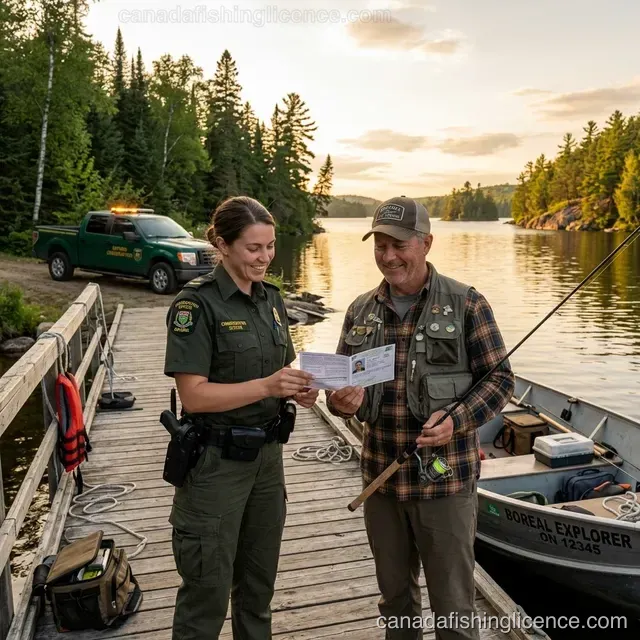
Who Are Conservation Officers?
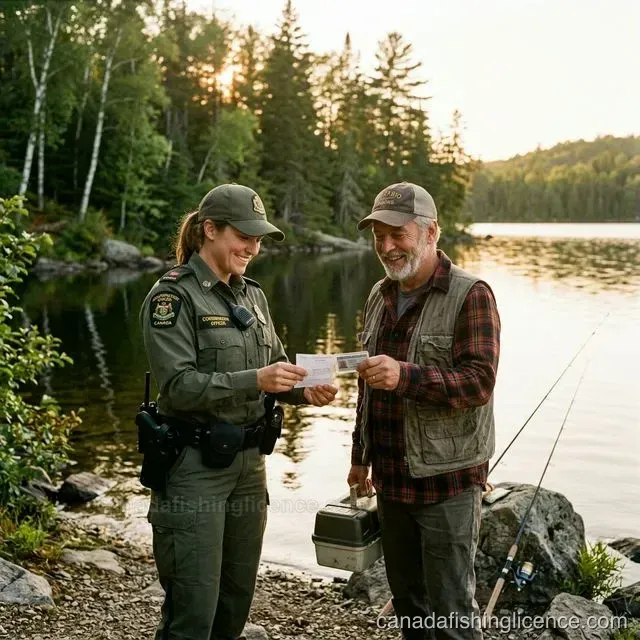
Conservation Officers may also be called Fish and Wildlife Officers, game wardens, natural resource officers, or fishery officers depending on the province or agency. Their exact powers come from the law that applies in that place, but fishing checks can include asking for licence proof, inspecting fish or gear, issuing tickets or summonses, seizing evidence, and dealing with serious offences.
Some encounters are mainly educational, and some are enforcement checks. The safer assumption is that the officer is there to confirm compliance, not to guarantee a warning. If you are new, be direct about what you know, show the documents you have, and ask which rule applies before you keep fishing.
Checks are more likely where many anglers gather, such as busy launches, stocked waters, shore spots, park docks, opening weekends, long weekends, and free-fishing events. Remote water does not remove the licence or catch-limit requirement; it only means you may be checked less often.
The Step-by-Step Encounter
A typical licence check may look like this:
Step 1 - They identify themselves. A uniformed officer will normally identify the agency they work for. Plainclothes or vessel-based officers should be able to show credentials when they are carrying out an inspection.
Step 2 - They ask to see your licence. Show the licence or summary in the form accepted by that province or system. Where digital proof is accepted, a phone copy may be enough, but a printed backup is safer in weak-signal areas. They may check your name, licence type (resident/non-resident, sport/conservation), valid dates (not expired), and any required stamps or cards (Salmon Conservation Stamp in BC tidal water, Outdoors Card in Ontario, WiN in Alberta). For a B.C. tidal trip, keep the catch records with the licence and remember that adult licence holders must complete the assigned iREC report by its deadline.
Step 3 - They may ask a few questions. The questions usually connect to compliance: what you are fishing for, whether you kept fish, where the fish are stored, and whether the species is in season. Answer directly. If you are not sure about a regulation, say so and ask which rule applies before you keep fishing.
Step 4 - They may inspect your catch. If you've kept fish, the CO may ask to see them in your cooler, on a stringer, or in a livewell. They may check species identification, size, count, and any length rule against the daily or possession limit. If you've already filleted fish, follow the local skin, packaging, and transport rule so the fish can still be counted and identified.
Step 5 - They wrap up. If everything checks out, the encounter may end quickly. If there is an issue, ask what document, rule, ticket, or next step the officer is referring to, then deal with the ticket or correction through the process listed on the notice.
What If You Don't Have Your Licence on You?
This is a common problem on remote or low-signal trips:
If you bought a licence but cannot show it (phone died, left the printout at home, cannot find the email): the officer may be able to check a database in some systems, but you should not rely on field lookup as your proof plan. Digital access, cell service, and officer workflow vary by province and location.
If you genuinely forgot it: you may still receive a warning, ticket, or instruction to produce proof later depending on the province and the situation. See the lost licence guide for how to get a replacement or reprint before the next trip.
How to avoid this entirely: Keep backups. (1) Save the licence PDF to your phone's photos/files app, not just email. (2) Email the PDF to yourself so you can find it later. (3) Print a copy and keep it in a ziplock bag in your tackle box. Many remote fishing spots have weak service, so the printed copy is practical.
What If You're Actually Breaking a Rule?
If an officer finds an issue, the possible outcomes vary:
Wrong licence type, missing stamp, or missing proof: the outcome depends on the statute, province, officer discretion, and facts of the stop. It may be a warning, ticket, summons, or instruction to correct the document problem. Do not assume a first mistake automatically gets a warning.
Over the catch limit: expect the officer to treat the retained fish, count, species, size, and possession limit as the main facts. Fish may be seized, and penalties can increase when each fish or each act counts as a separate offence under the local law.
No licence at all: penalties vary by province and situation, and your catch may be seized. Finding the correct portal through the official portal links usually takes less effort than trying to explain a missing licence at the water.
Serious violations (closed sanctuaries, protected species, obstruction, repeat offences, or commercial-scale conduct) can lead to larger penalties, seizure, licence suspension, court orders, or charges. For penalty ranges, use the dedicated fine guide and the official provincial regulation for the place you are fishing.
Key point: if an officer finds a problem, stay factual. Ask what rule or document issue is being cited, keep the ticket or notice, and use the listed dispute or correction process if you think there is a mistake.
Your Rights During a Check
Know the practical inspection boundaries:
Show the licence or proof the local rule requires. Fishing is a regulated activity, so refusal to produce a required licence, permit, card, tag, or catch record can become its own problem. Follow the officer's instructions and ask for the specific rule if you are unclear.
Inspection powers vary by province. Fish-and-wildlife laws often let officers inspect fish, coolers, livewells, gear, boats, vehicles, camps, or containers when the legal threshold is met. The exact warrant, search, seizure, and identification rules are set by the law in that province or federal fishery.
You can ask for identification. If someone in plainclothes claims to be an officer, ask to see official credentials before handing over documents or catch.
You can use the listed dispute process. A ticket or summons tells you what process applies. If you bought a licence but could not show it, gather the official proof and follow the correction or court steps printed on the notice.
How to Prepare So It Takes 30 Seconds

Make a CO check the easiest 30 seconds of your fishing day:
Before your trip: Download the free provincial regulations summary PDF from your province's Fish and Wildlife website. Check your licence expiry date. Confirm the species you're targeting is in season for your zone with the season calendar. Know your catch and possession limits. Check for any gear restrictions (barbless hooks, lead tackle bans, live bait restrictions).
On the water: Keep your licence accessible — not buried in the bottom of your tackle bag. If you're keeping fish, keep a rough mental count. Know the minimum size for your target species. If you're not sure about a fish, measure it before deciding to keep it. A bump board in your tackle box makes this fast.
If an officer approaches: keep your licence ready before they have to ask twice. Answer direct questions plainly. If you do not know a regulation, say so and ask which rule applies. If you made a mistake, keep the conversation factual and follow the process on the notice.
The simple goal is to remove uncertainty before the officer has to ask twice. Keep the proof accessible, keep the catch easy to inspect, and do not guess when the right answer is to check the rule.