Salmon Fishing Licence Canada 2026: Stamp, Permits and Province Rules
Salmon fishing often needs more than a standard licence. The exact stamp, tag, or permit depends on the province and the water you are fishing.
Quick Planning Checklist
If you plan to keep a salmon, check these three points before the trip:
Buy the right add-on or tag. In BC freshwater, this can be the non-tidal Salmon Conservation Surcharge. In BC tidal water, it is the $7.39 DFO Salmon Conservation Stamp. Out East, it can be a salmon licence, river permit, or tag.
Record it right away. When you decide to keep the fish, mark the licence or attach the tag as required by the local rule. Do not wait until you get back to the dock.
Know your species limits. A Chinook is not a Pink. Check the specific limit for the species you caught in your exact location.
Salmon trips often need additional permits, stamps, surcharges, tags, or river checks. In BC, freshwater salmon retention can require the provincial non-tidal Salmon Conservation Surcharge, while tidal salmon retention uses a DFO tidal licence plus the 2026/2027 Season DFO Salmon Conservation Stamp ($7.39). Atlantic provinces and Quebec use salmon-specific permits and river-level rules.
- BC freshwater: provincial licence plus non-tidal Salmon Conservation Surcharge when retention requires it
- BC tidal: DFO tidal licence plus 2026/2027 DFO Salmon Conservation Stamp ($7.39)
- New Brunswick: salmon licence plus guide or Licence to accompany checks for many non-resident trips
- Nova Scotia: separate Salmon Fishing Licence and current river-level salmon rules
- Ontario: Sport versus Conservation affects harvest limits
- Quebec: salmon river permits, access rules, and quotas vary by river
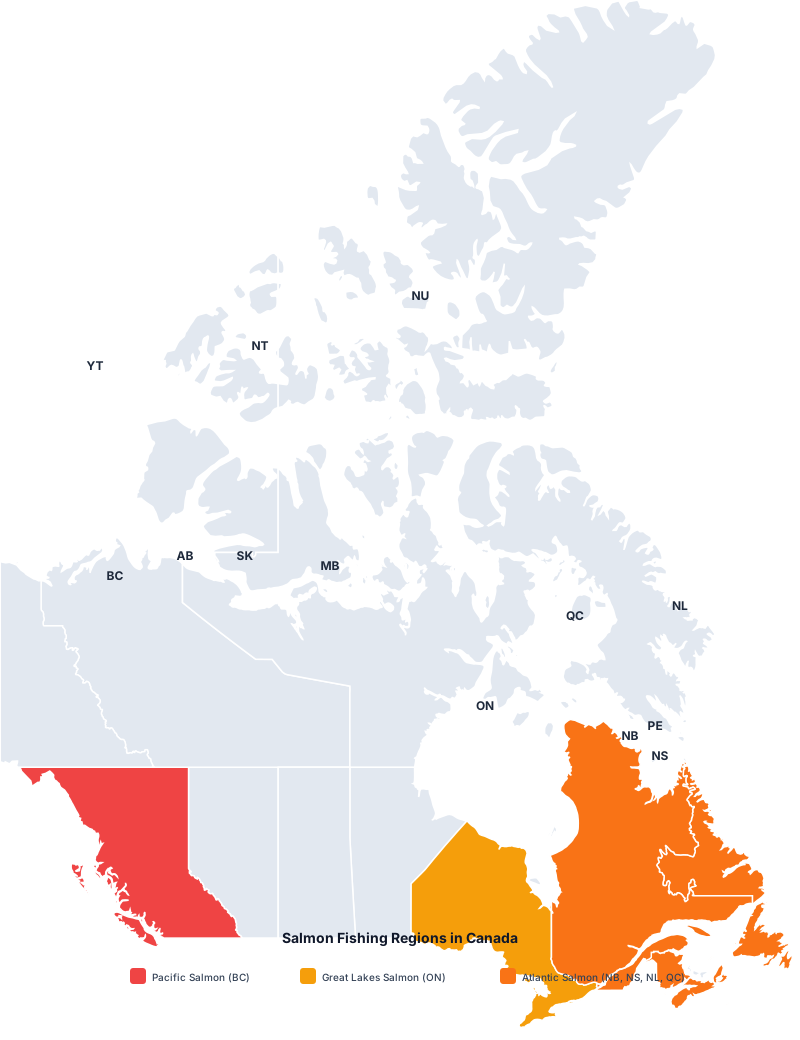
Where Are You Fishing for Salmon?
Salmon rules change a lot by region. Pick the section that matches your trip:
Official Salmon Rule Links
Salmon rules can change by area, river, species, and in-season notice. Check the official source for the water before keeping fish.
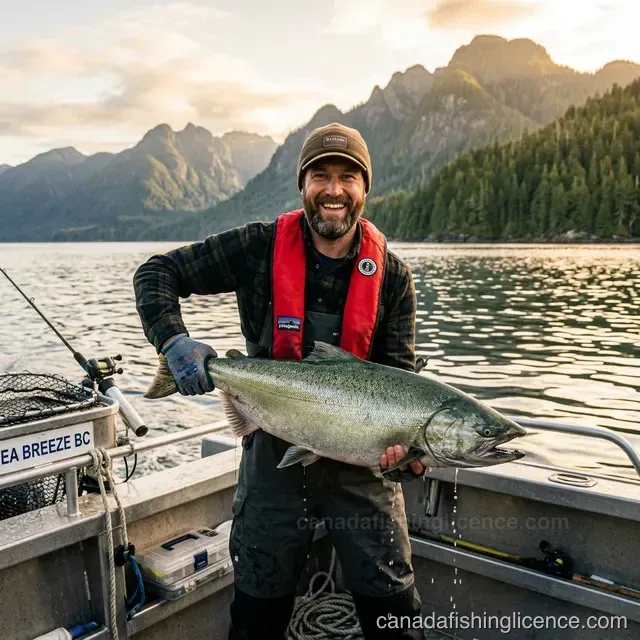
Pacific Salmon (British Columbia)
British Columbia has five Pacific salmon species in its tidal fishery: Chinook, Sockeye, Coho, Pink, and Chum. To keep any salmon caught in saltwater, you need a federal DFO tidal licence plus the Salmon Conservation Stamp ($7.39).
What it looks like in practice: When you buy your tidal licence online at the NRLS portal, the system asks whether you want to add the Salmon Conservation Stamp. If you plan to keep salmon where retention is open, add it at checkout. Without it, treat salmon as release-only and still check whether the area is open to salmon fishing.
As of April 1, 2026, BC's new WILD licensing system replaces the old freshwater portal. Freshwater salmon add-ons are handled through the provincial path, while the DFO tidal licence and Salmon Conservation Stamp are purchased separately through the federal NRLS portal.
BC Tidal Waters Licence Pricing
| Licence Type | Resident (16-64) | Senior (65+) | Non-Resident |
|---|---|---|---|
| Annual | $25.86 CAD | $13.54 CAD | $124.41 CAD |
| 5-Day | $19.70 CAD | — | $38.18 CAD |
| 3-Day | $13.54 CAD | — | $23.40 CAD |
| 1-Day | $6.46 CAD | — | $8.62 CAD |
| Salmon Conservation Stamp | $7.39 CAD | $7.39 CAD | $7.39 CAD |
2026/2027 Season DFO Salmon Conservation Stamp ($7.39) is required in addition to retain any Pacific salmon.
Atlantic Salmon
Atlantic salmon fishing in NB, NS, NL, and QC is tightly managed. Many rivers have release-only rules or extra access controls, and some waters use separate river permits. If your trip includes Atlantic salmon, read the province- and river-specific rules before you travel.
New Brunswick
NB includes major Atlantic salmon rivers such as the Miramichi and Restigouche. Non-resident salmon licences are divided into classes: Class 1 Season ($173 + HST), Class 2 seven-day ($100 + HST), and Class 3 three-day ($53 + HST). Crown Reserve Waters offer allocated rod-per-day access for prime salmon and brook trout angling.
In New Brunswick, non-resident Atlantic salmon trips can require a licensed guide or a New Brunswick resident who holds the proper Licence to accompany. Check the exact water and date before booking.
Important (2026): There is a mandatory hook and release (catch-and-release) requirement for all sea-run Atlantic salmon on all New Brunswick waters. This means if the salmon has been to the ocean and come back, treat it as release-only unless the current DFO and provincial rules clearly say otherwise. Check in-season notices for any updates.
Nova Scotia
Atlantic salmon in Nova Scotia fresh water uses a separate Salmon Fishing Licence, not the ordinary General Fishing Licence. River-level salmon rules and current notices still decide whether fishing is open and what must be released.
Check the Nova Scotia Atlantic salmon licence guide before buying if the trip depends on Nova Scotia salmon.
Newfoundland & Labrador
NL has major Atlantic salmon rivers such as the Humber, Exploits, and Gander. Scheduled salmon rivers are managed by DFO and may require additional permits or tags. Non-residents should check the Department of Fisheries, Forestry and Agriculture for specific river regulations and any quota limitations that apply to their fishing area.
Quebec
Quebec salmon planning is river-specific. Each river can have its own rules and its own permit, and some rivers use a lottery system where you need to apply in advance. This is not a good last-minute decision. Rivers are organized into zones (ZECs and controlled zones), and you must register your catches daily. Limits can be strict, often just 1 salmon per day, and some rivers have total season quotas.
Mandatory Salmon Tagging & Catch Recording
Salmon are carefully managed across Canada. Catch recording and tagging rules are part of the licence, not an optional extra.
If the local rule requires licence notching, catch recording, or a physical tag, do it where the fish is caught. Do not wait until you return to the dock, reach your vehicle, or clean the fish.
Great Lakes Salmon (Ontario)
Ontario's Great Lakes support introduced Pacific salmon populations (Chinook, Coho) and Lake trout. Ontario does not sell a separate salmon stamp for ordinary Great Lakes salmon fishing, but Sport and Conservation licences carry different catch and possession limits. Lake Ontario and Lake Huron offer Chinook and Coho opportunities in the right season and zone.
In Ontario, check Sport versus Conservation before you plan to keep fish. Conservation licences carry reduced limits, and the exact salmon or trout answer still depends on the zone, species, and waterbody exception.
Proof tip: After you buy your licence and required add-ons online, save the accepted proof where you can reach it without cell service. In BC, follow the paper-licence notching instructions when you keep salmon, and complete the required record before leaving the water.
Check the licence, stamp, tag, guide, and recording rules before you keep salmon. Violations can lead to fines and seizure of catch or gear, and serious Fisheries Act offences can be much higher.
Frequently Asked Questions
Do I need a special licence to fish for salmon in Canada?
Usually, yes. Salmon trips often need something beyond a basic fishing licence. In BC freshwater, salmon retention can require the provincial non-tidal Salmon Conservation Surcharge. In BC tidal waters, you buy a saltwater licence and add the $7.39 Salmon Conservation Stamp if you plan to keep Pacific salmon. In Atlantic Canada and Quebec, salmon rivers may need separate permits, tags, guide requirements, or river-specific checks. Ontario does not use a separate salmon stamp, but Sport versus Conservation affects harvest limits.
What is a Salmon Conservation Stamp?
The BC Salmon Conservation Stamp is a $7.39 add-on to your DFO tidal waters licence for the 2026/2027 season. It is needed if you plan to retain Pacific salmon in tidal water where retention is open. It is separate from BC's freshwater non-tidal Salmon Conservation Surcharge.
Can I fish for Atlantic salmon anywhere in Canada?
Atlantic salmon fishing is highly regulated. In New Brunswick, a non-resident season salmon licence costs $173 plus HST. In Nova Scotia, Atlantic salmon in fresh water uses a separate salmon licence and river-level salmon rules. In Newfoundland and Labrador, scheduled salmon rivers have their own licence and river-class checks. Quebec has a separate salmon licence path and river-specific access rules.
What salmon species can I catch in BC?
BC has five Pacific salmon species: Chinook (King), Sockeye (Red), Coho (Silver), Pink (Humpy), and Chum (Dog). Each species has specific retention limits, size restrictions, and seasonal closures that vary by fishing area. Check DFO in-season regulations.
Is there a limit on how many salmon I can keep?
Yes, but there is no Canada-wide salmon limit. BC limits vary by species, tidal or freshwater area, and in-season notice. Atlantic salmon limits vary by province, river, classification, tag, and release rule, and some waters are release-only.