| Situation | Boating proof path | Fishing licence still needed? |
|---|---|---|
| You operate your own motorized pleasure craft | PCOC or another accepted proof of competency. | Yes, for the water and species you fish. |
| You rent a boat | A completed rental-boat safety checklist can serve as proof for the rental period. | Yes. |
| You are a visitor with home-country operator proof | Transport Canada lists a visitor's home-state or home-country operator document as accepted proof in the right situation. | Yes, usually as a non-resident angler. |
| You paddle a canoe, kayak, or rowboat with no motor fitted | Proof of competency is not required for a non-powered pleasure craft. | Yes, if the fishery requires one. |
Do You Need A PCOC For Boat Fishing?
The Pleasure Craft Operator Card (PCOC) is the common proof of competency for operating a recreational boat with a motor in Canada. Transport Canada says the rule applies to motorized pleasure craft, including electric trolling motors, and can still matter even when the motor is not in use.
The card is not a fishing licence. It proves boating knowledge for the operator, while the fishing licence or permit covers the fishery. If you are driving a motorized fishing boat, plan for both documents unless another accepted proof of competency or visitor/rental rule applies.
A PCOC is valid for life once issued. The course and test are handled by Transport Canada-accredited providers, so check the provider list and current fee before you start.
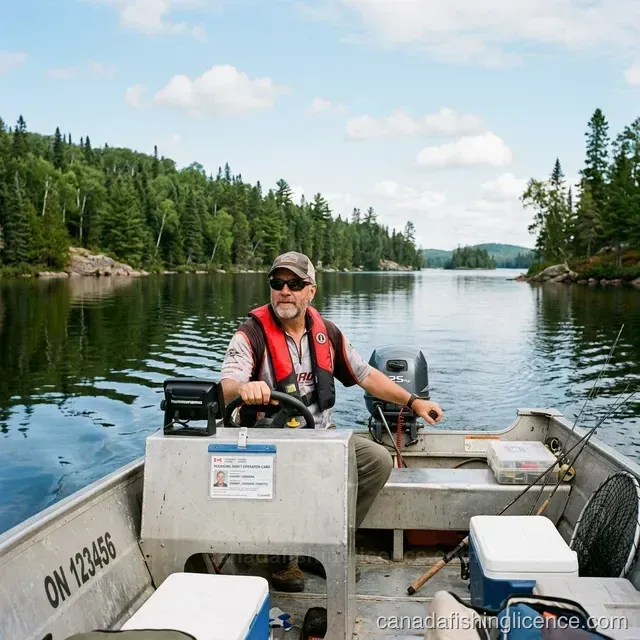
Who Needs One?
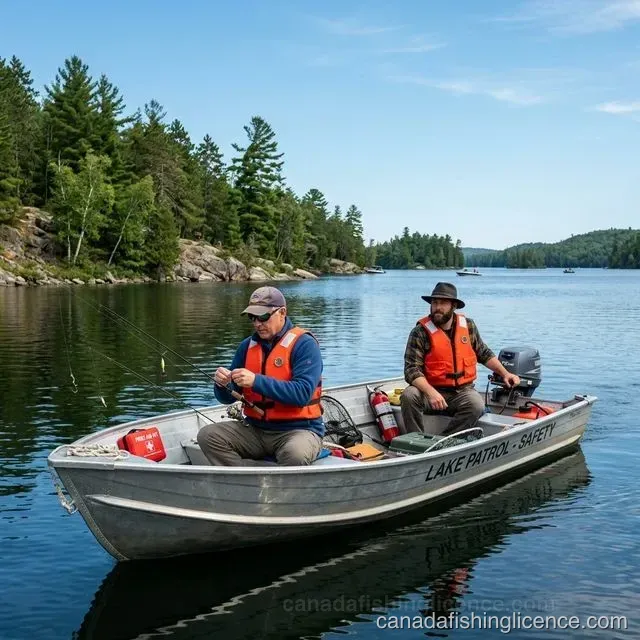
Yes, if you are operating a recreational boat with a motor and do not have another accepted proof of competency. This includes outboards, inboards, personal watercraft, sailboats with auxiliary motors, and electric trolling motors.
No, if you're only using human-powered boats. Canoes, kayaks, rowboats, and paddleboards don't require a PCOC (but you still need PFDs and safety equipment).
No, if you're only a passenger. Only the person operating the boat needs the card. Passengers don't need one.
Territory and visitor exceptions: Transport Canada says proof of competency is not currently required in the Northwest Territories or Nunavut. A visitor operating their own boat in Canada for less than 45 consecutive days is also exempt from the Canadian proof-of-competency rule, but must carry proof of residence. The Yukon and the rest of Canada still require the applicable proof for motorized pleasure craft.
The age check: Youth under 16 can operate a motorized boat with restrictions such as engine size limits and supervision. Adults operating a motorized pleasure craft should carry a PCOC or another accepted proof of competency unless a visitor or rental rule clearly applies.
The practical point: Carry the accepted proof while operating. A phone photo or paper copy of a PCOC is not accepted as the card itself; use the document or visitor/rental proof that Transport Canada lists for your situation.
How to Get Your PCOC — Step by Step
Step 1: Choose a Transport Canada-accredited provider. Only accredited providers can issue valid PCOCs. Check the current provider list, language options, and fee before you start.
Accredited providers follow Transport Canada requirements, so choose based on current price, language, interface, and support rather than assuming one card is more valid than another.
Step 2: Take the online course. Budget about two hours. The course covers navigation rules, buoy markers, right-of-way, safety equipment requirements, and emergency procedures. Many providers let you pause and resume, but check the course rules before you begin.
Step 3: Pass the test. The accredited provider sets the current test process and retake rules. Read the provider's instructions carefully and confirm what proof you will receive after passing.
Step 4: Receive your card. Many providers issue a temporary proof while the permanent card is prepared. Save the accepted proof where you can reach it before operating a motorized pleasure craft.
Step 5: Keep accepted proof with you whenever boating. Carry the PCOC or other accepted proof while operating a motorized pleasure craft. A paper or electronic copy of the PCOC is not accepted as the card itself, so keep the accepted document where you can reach it.
PCOC, Rental Checklist, Visitor Proof, Or No Motor?
The quickest way to avoid buying the wrong thing is to separate the operating situation before choosing a course:
The practical point is that the fishing side and the boating side stay separate. Start with the water, then check the craft, then decide whether a PCOC or another accepted proof applies.
What the Test Covers (No Surprises)
The PCOC test covers practical boating safety topics such as:
Navigation rules: Port vs. starboard, crossing situations, passing other boats, night navigation lights. A common rule of thumb is that the boat on the right has priority at intersections, but the full navigation rules still apply.
Buoys and markers: Red vs. green buoys, lateral buoys, cardinal buoys, and special markers. The mnemonic: "Red Right Returning" — keep red buoys on your right when returning from open water.
Safety equipment: What you are legally required to carry, such as PFDs, bailer, paddle, whistle or horn, navigation lights for night operation, and a fire extinguisher for certain boats.
Speed and wake: No-wake zones, speed limits near shore, and your responsibility for damage caused by your wake.
Emergency procedures: What to do if someone falls overboard, boat capsizes, or you encounter distress signals. The key: always throw a flotation device FIRST before attempting rescue.
Tip: Do not rush through the course just to get to the test. Pay particular attention to PFD requirements, required equipment, and emergency procedures.
PCOC vs. Fishing Licence — The Difference
These are two completely separate documents issued by different authorities:
PCOC (Boating Card): Federal (Transport Canada). Required to drive a motorized boat. Valid for life. One-time purchase. Same card works everywhere in Canada.
Fishing Licence: Provincial or federal (DFO for tidal). Required to fish. Annual renewal. Province-specific. Some species require additional stamps.
To go motorized boat fishing, you need BOTH: A PCOC to operate the boat + a fishing licence to fish. Neither replaces the other.
If you're fishing from someone else's boat and they're driving, you only need a fishing licence (the driver needs the PCOC). See our boat fishing guide for full details on boat regulations while fishing.
Minimum Safety Equipment for Your Fishing Boat
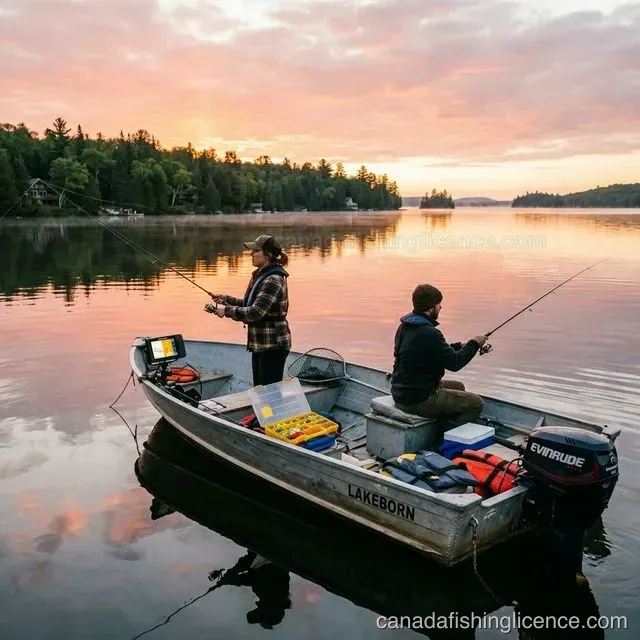
While you're getting your PCOC, here's what you'll learn you need to have on board. For boats under 6 metres (most fishing boats):
PFD/lifejacket for every person on board — properly sized, accessible (not buried under seats), Transport Canada-approved. Kids should wear theirs when underway, not just have one available.
Bailer or manual bilge pump — for removing water from the boat.
A paddle or oar — in case the motor fails.
Sound-signalling device — whistle or air horn. Attached to your PFD is ideal.
Navigation lights — required if operating at night, dusk, or dawn, or in reduced visibility.
A watertight flashlight OR 3 approved flares — for emergency signalling.
15 metres of buoyant heaving line — for throwing to someone in the water.
Not legally required but highly recommended: VHF marine radio (useful for larger lakes), first aid kit, charged phone in waterproof case, anchor and line, tool kit, extra fuel, sunscreen and water.
For a small fishing boat, the exact safety gear list depends on the boat and how it is used. Organize the required items where people can reach them quickly, not buried under coolers or tackle.