| Test | Result | Species |
|---|---|---|
| Dark mouth with black gums? | Yes; tail spots on both lobes | Chinook (King) |
| Light mouth and spots mainly on upper tail? | Square tail with a wide base | Coho (Silver) |
| No spots on body or tail? | Moderately forked tail; green head/red body in spawning fish | Sockeye (Red) |
| No spots and silver streaks on part of tail? | Narrow tail base; vertical bands can appear when spawning | Chum (Dog) |
| Large oval spots on both tail lobes? | Smallest species; males develop a hump | Pink (Humpy) |
| Uniform small spots on a square tail? | Slender profile; no throat teeth | Steelhead (sea-run trout) |
5 Species, 5 Key Differences
DFO's B.C. identification guide covers 5 Pacific salmon species: Chinook (King), Coho (Silver), Sockeye (Red), Pink (Humpy), and Chum (Dog). Knowing which species you've caught matters because rules can differ by species, area, and notice. Chinook, Coho, Sockeye, Pink, and Chum do not always share the same retention answer.
Here's the quick cheat sheet: Chinook = dark mouth and spots on both tail lobes. Coho = light mouth with spots mainly on the upper tail lobe. Sockeye = no spots, blue-green or red by life stage. Pink = small with large oval spots on both tail lobes. Chum = no spots in the ocean phase or vertical side bands when spawning.
If you plan to keep salmon in BC, first separate freshwater from tidal water. Freshwater salmon retention can require the provincial non-tidal Salmon Conservation Surcharge, while tidal salmon retention requires a DFO tidal waters licence plus the Salmon Conservation Stamp. The tidal stamp is an add-on, not an automatic part of the base licence.
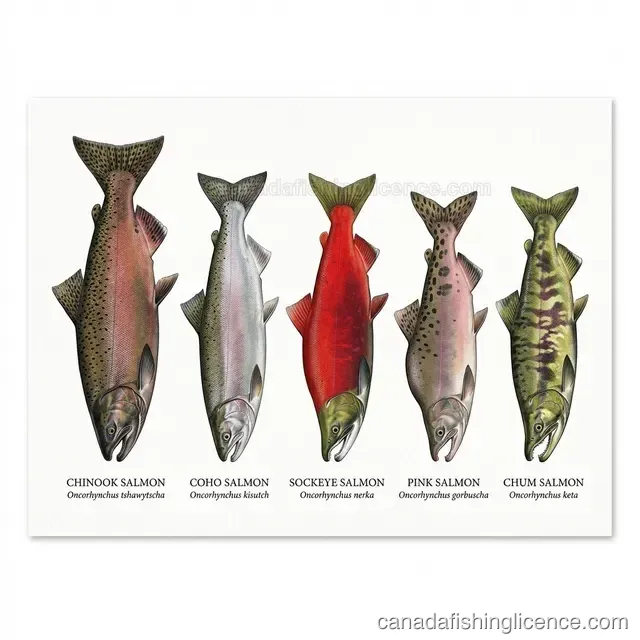
Chinook Salmon (King Salmon) — Oncorhynchus tshawytscha
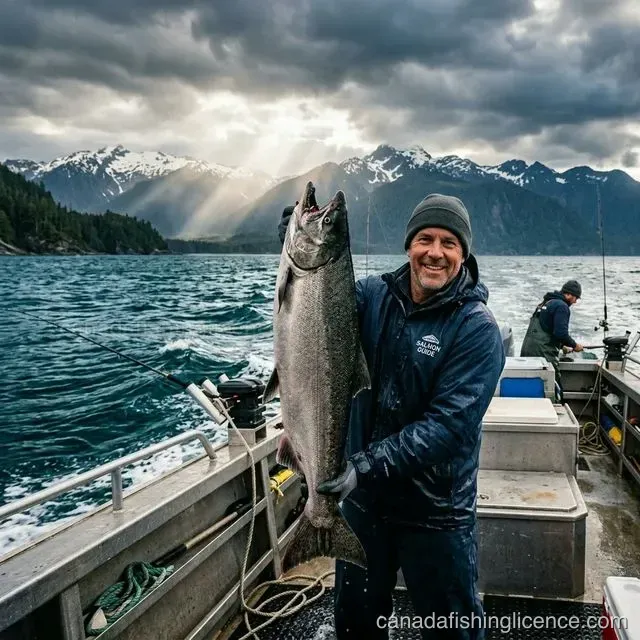
The biggest one. Chinook are usually the largest Pacific salmon an angler encounters. Size helps, but mouth colour and tail spots are better checks than size alone.
How to identify:
• Black mouth — Look inside the lower jaw. Chinook commonly have a distinctive dark or black gum line. This is one of the strongest quick checks when separating Chinook from Coho.
• Spots on BOTH lobes of the tail — Small irregular black spots cover the entire tail fin (upper and lower lobes).
• Spots on the back and dorsal fin — Black spots scattered across the upper back and dorsal fin.
• Size varies — Chinook can be large, but size overlaps among species. Use the mouth and tail features as the main checks.
When you'll see them: Timing depends on the river system and management area. Spring, summer, and fall Chinook opportunities should be checked against the current DFO notice for the exact water.
2026 regulatory significance: Chinook carry some of the strictest Pacific salmon rules. Daily limits, retention, mark-selective opportunities, and barbless-hook requirements can change by DFO area and notice. Always check DFO in-season notices and the specific area regulations before keeping any Chinook.
Coho Salmon (Silver Salmon) — Oncorhynchus kisutch
The acrobatic one. Coho often jump hard when hooked, but behaviour alone is not enough for identification.
How to identify:
• Silver sides (in ocean) — Bright silver colouring is common before spawning colours develop.
• Spots on UPPER tail lobe only — This is the key difference from Chinook (which has spots on both lobes). Look closely — this single distinction separates the two most commonly confused species.
• White/light gum line — Inside the mouth is lighter coloured, unlike Chinook's black gums. Check the jaw.
• Medium size — Coho are often smaller than Chinook, but size overlaps. Use the light gum line and upper-tail spotting with the other features.
When you'll see them: Coho timing is often a fall planning question, but the exact answer depends on the river, DFO area, and current opening.
Hatchery vs. wild — the adipose fin test: In mark-selective fisheries, retention can depend on whether the adipose fin is clipped. DFO's Salmon Head Recovery Program asks anglers to submit heads from some hatchery-marked Chinook and Coho so coded-wire tags can be recovered. Check the DFO Pacific instructions and current area rule before keeping a marked fish.
Sockeye Salmon (Red Salmon) — Oncorhynchus nerka
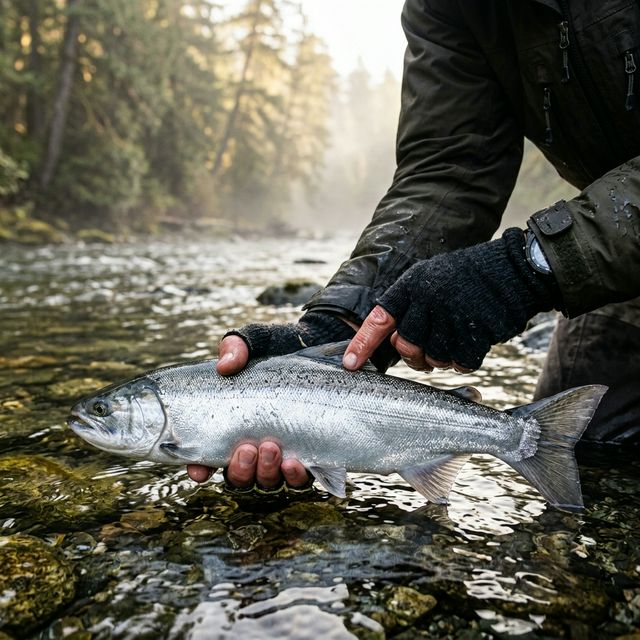
The colour-change one. Sockeye can shift from blue-green in the ocean to a red body with a green head during spawning.
How to identify:
• NO spots — Sockeye have no distinct black spots on the body, back, or tail. This is the easiest way to distinguish them from Chinook, Coho, and Pink (all of which have spots).
• Blue-green back (ocean phase) — Steel blue-green colour on back with bright silver sides.
• Bright red body + green head (spawning) — A useful colour-stage clue when combined with the lack of spots.
• Compact body — Sockeye have a streamlined, torpedo-shaped body. Use the lack of spots and the body colour as the primary checks.
When you'll see them: Sockeye timing depends on the system and cycle year. The Fraser River is the best-known example, but run strength and fishing opportunity are not the same thing.
Regulatory alert: Sockeye fisheries can change quickly based on in-season run information. Check DFO in-season fishery notices before targeting Sockeye and again before keeping one.
Pink Salmon (Humpy) — Oncorhynchus gorbuscha
The small run-year one. Pink salmon are the smallest Pacific salmon and can be abundant during run years.
How to identify:
• Large, oval black spots on back and BOTH tail lobes — Similar to Chinook but the spots are noticeably larger and more oval-shaped (Chinook spots are smaller and more irregular).
• Small size — Pink are the smallest Pacific salmon. If you see a small, spotted salmon, check the large oval spots and tail shape before deciding.
• Male hump (spawning) — Males develop a pronounced dorsal hump during spawning, giving them the nickname "Humpy."
• V-shaped tail with large oval spots on both lobes — Pair this with the small body and, in spawning males, the pronounced hump.
Run-year planning: Pink salmon have a two-year lifecycle. Many mainland B.C. systems have strong odd-year patterns, while some local even-year runs exist. Check the current DFO notice for the exact system before planning a Pink-focused trip.
Why it matters: During strong run years, Pink salmon opportunities can be easier to find, but retention still depends on the area, date, and current notice.
Chum Salmon (Dog Salmon) — Oncorhynchus keta
The late-run one. Chum salmon can grow large and are often encountered in fall fisheries.
How to identify:
• NO spots (ocean phase) — Like Sockeye, ocean-going Chum lack distinct spots. They're silver with a blue-green back.
• Calico bars (spawning) — During spawning, Chum develop distinctive vertical bars of red, green, and purple along their sides. Males also grow large, curved "dog teeth" (hence "Dog Salmon").
• Distinctive tail and body pattern — Chum have no spots on the back or tail, a narrow tail base, and silver streaks covering part of the tail in the DFO comparison table.
When you'll see them: Timing depends on the river system, management area, and current opening. Check the current notice before targeting or keeping Chum.
Why it matters: Chum regulations vary by river and area. Some waters allow retention; others are catch-and-release only, and the answer can change by notice.
The Steelhead Trap — Don't Confuse Steelhead with Salmon
This is a high-risk misidentification. Steelhead (Oncorhynchus mykiss) are not salmon — they are sea-run rainbow trout. They can look similar enough to Pacific salmon that anglers confuse them, especially in rivers where both are present.
How to identify Steelhead (and avoid keeping one by mistake):
• Small, scattered spots across the ENTIRE tail — Unlike salmon spots, Steelhead have fine spots distributed evenly across the entire tail fin
• Square-ish tail — Steelhead tails are less forked than salmon tails
• Pink/red lateral stripe — A rainbow-like band along the side (more visible in spawning fish)
• White mouth — No black gum line (unlike Chinook)
• Silvery overall — In ocean/river entry phase, very chrome and bright
Why this matters: Steelhead retention rules can be strict or release-only by water and notice. Do not use a general salmon rule to decide whether a trout-like fish may be kept.
If you catch a trout-like fish in a B.C. river during salmon season and you're not certain of the identification, release it and check the current DFO area rule before keeping another.
Hatchery vs. Wild — The Adipose Fin Test
In some B.C. mark-selective fisheries, the adipose fin is one part of the retention check. This is a physical feature to inspect, not a substitute for the current area rule:
The adipose fin is a small, fleshy fin located between the dorsal fin and the tail. A clipped fin can indicate a hatchery-marked fish, while an intact fin is not by itself a permission to retain the fish. Confirm the current DFO notice and species rule before keeping it.
Why DFO clips the fin: Some hatchery fish receive coded-wire tags before release. The clipped adipose fin can signal that a tag may be present and that DFO wants the head submitted if the fish is legally retained. Check the Salmon Head Recovery Program instructions for the current drop-off path.
Mark-selective fisheries: In designated areas, retention can depend on whether the fish is hatchery-marked, meaning the adipose fin is clipped. Some Chinook opportunities also carry single-barbless-hook requirements. Always check the specific DFO area regulation and current notice before keeping a marked Chinook or Coho.
How to check: Before keeping any Chinook or Coho where mark status matters, look along the back between the dorsal fin and the tail. A smooth area may mean the adipose fin has been clipped; a small, soft fin means it is present. Check carefully before any retention decision.
Quick ID Cheat Sheet For The River
Still not sure? Take a photo and release the fish. Check the ID later. When in doubt, treat it as release-only and keep fishing only after you understand the current rule for the area.
Laminated ID cards: Start with DFO's Identify your catch guide or the GoFishBC site. Save the current reference before your trip rather than relying on a remembered rule.